
The GEO Playbook
Citation Should Be Engineered, Not Chased
The GEO Playbook is a book by Jenifer Prince Dhas Pushpadhasan that lays out a Citation Authority System — a practical approach to Generative Engine Optimization for making a brand the answer AI engines trust, cite, and amplify. Instead of chasing individual mentions, it's a structured way to build the citation-worthy content and entity data that earn a brand a place inside AI-generated answers, consistently.
📖 Available on Amazon Kindle and Paperback
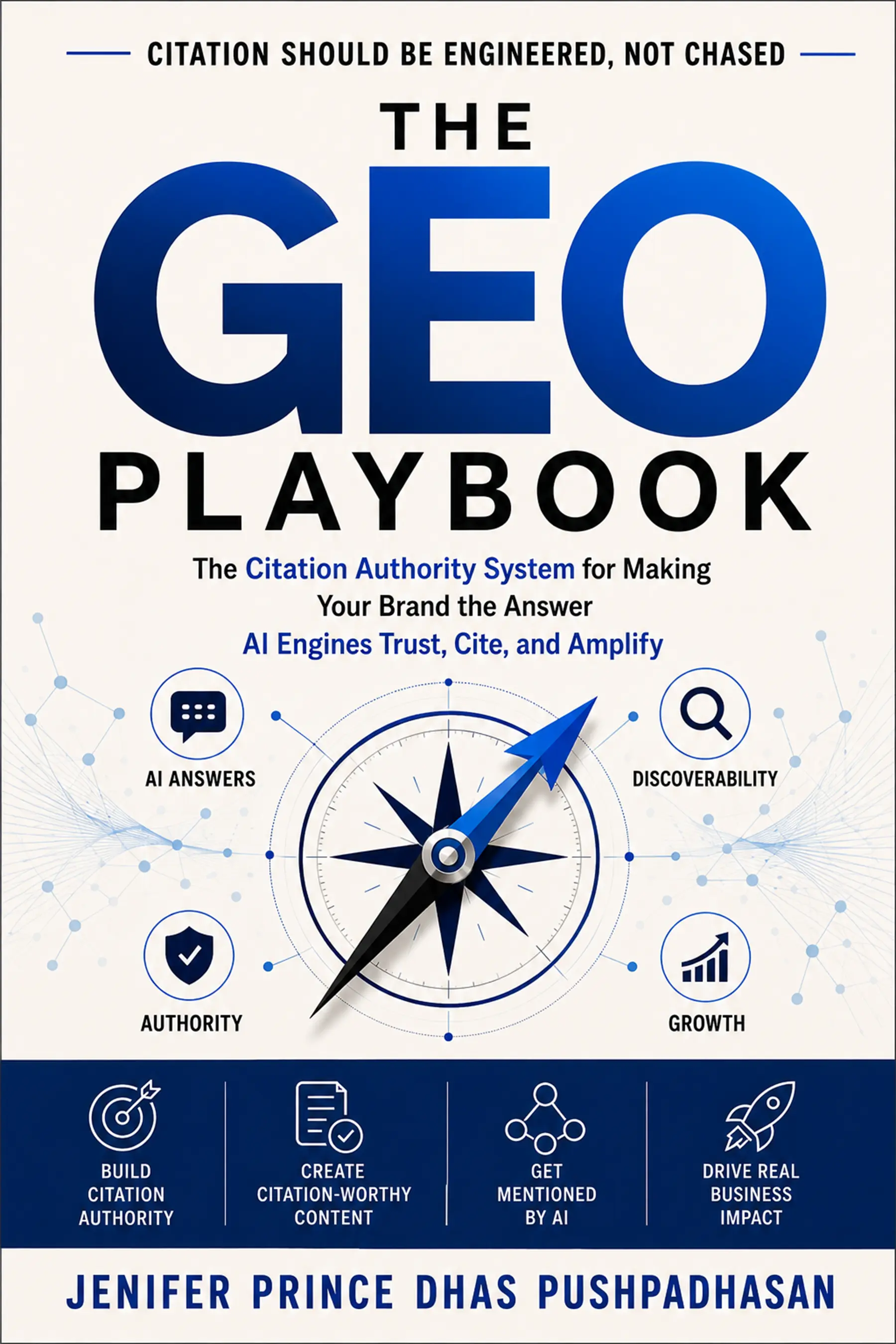
"Citation should be engineered, not chased." — Jenifer Prince Dhas Pushpadhasan, The GEO Playbook
What This Book Is About
Getting mentioned by an AI engine once is luck. Getting cited consistently, across the questions that matter to your buyers, is a system. The GEO Playbook makes the case that Citation Authority — the standing that gets a brand treated as a trustworthy source by ChatGPT, Gemini, and Perplexity — shouldn't be left to chance or pursued one mention at a time. It should be engineered: built deliberately through structured content, schema, and entity data designed to be read, trusted, and cited by AI systems.
The book positions this as a repeatable system rather than a one-off tactic, connecting the discoverability, authority, and content work that earns citations to the real business impact those citations are meant to produce.
What You'll Learn
The GEO Playbook is built to help you do four things:
Build Citation Authority. Establish the entity consistency and structured data that give AI engines a reason to treat your brand as a trustworthy source in the first place.
Create Citation-Worthy Content. Structure content so it's genuinely useful to extract and quote — not just written to be read, but built to be the cleanest available answer to a real question.
Get Mentioned by AI. Turn citation-worthy content and established authority into actual, trackable mentions inside AI-generated answers.
Drive Real Business Impact. Connect AI citations back to the business outcomes they're meant to serve, so visibility in AI answers is measured as a growth input, not a vanity metric.
Who This Book Is For
The GEO Playbook is written for growth marketers, SEO professionals, founders, and agency owners who want a structured way to earn AI citations — particularly anyone who has already seen individual AI mentions happen by accident and wants to understand how to make that repeatable.
Chapter Overview
Part I — The New Search Reality (Chapter 1). From Strings to Things: how AI engines actually think, and why that shift changes what "visibility" means.
Part II — The Citation Architecture (Chapters 2–8). Citation Authority as the metric that replaces Domain Authority; why the Zero-Click World makes traffic the wrong thing to optimize for; the difference between AEO and GEO; building a Knowledge Graph as your brand's permanent intelligence layer; the Source of Truth — a private intelligence database that makes AI output uncopiable; Information Gain, the metric that determines whether AI cites you; and Schema Architecture for making content machine-readable.
Part III — Signal Density and Distribution (Chapters 9–11). Why Signal Density means one great article is never enough; the Semantic Echo for building cross-platform entity authority; and the hidden citation layer inside Reddit and forums.
Part IV — The Feedback System (Chapters 12–14). The GEO Audit — a complete 5-block assessment for any brand; Gap Analysis for finding the white space competitors don't own; and the GEO Command Center for measuring what actually matters.
Part V — GEO by Industry + Bonus Modules (Chapters 15–18). Applying GEO to B2B SaaS, D2C and e-commerce, personal brands and thought leaders, and agencies selling Citation Authority as a service — plus a 90-Day GEO Installation Plan, a GEO Content Checklist, 10 GEO Prompts for building Citation Authority, the GOSEO Labs Tool Stack, and a full glossary.
Glossary
Terms as used throughout this book, in alphabetical order.
AEO (Answer Engine Optimization)
The discipline of structuring content to be retrieved and surfaced directly in AI-generated answers and featured snippets — focused on concise, extractable, single-entity responses.
Author Entity
A schema-based representation of a piece of content's human author, linking name, credentials, and verified profiles (via sameAs) so AI engines can assess the author's expertise and trustworthiness.
Brand Entity
The core, top-level entity in a brand's Knowledge Graph, representing the company or product itself, around which Target Entities and Adjacent Entities are organized.
Citation Authority
The degree to which an AI engine trusts and selects a brand as a source when generating synthesized answers for users in its category — the central metric this book is built around.
Citation Share
The percentage of relevant AI-generated answers in which a brand is cited as a source, tracked across a defined Query Set; the primary metric that replaces traditional ranking position.
Cluster Node
A focused, specific Knowledge Node (800–1,500 words) that supports a Pillar Asset by covering an adjacent or narrower subtopic, linking back to strengthen the Pillar Asset's authority.
Cost Per Citation
A GEO Command Center metric measuring the content investment required to earn each additional AI citation, used to evaluate the efficiency of a content program.
Declarative Answer
A direct, confidently stated answer to a specific question, placed early in content, that both AEO and GEO rely on as the shared foundational unit AI engines extract and cite.
Distribution Waterfall
The four-stage process — Source Node, Deconstruction, Native Adaptation, Persistence Loop — for turning one piece of core knowledge into multiple platform-native signals distributed over time.
Domain Authority
A legacy third-party SEO metric estimating a website's overall ranking strength based on backlink volume and quality; contrasted throughout this book with Citation Authority as a measure built for the wrong kind of search engine.
Entity Closeness Score
A measure of how tightly and consistently a brand is associated with its Target Entities across the web and in AI models, contributing to whether an AI recommends the brand in relevant contexts.
GEO (Generative Engine Optimization)
The discipline of structuring, distributing, and reinforcing a brand's knowledge so that generative AI engines synthesize it into their answers and cite it as a source — the subject of this book.
GEO Command Center
The five-metric measurement framework — Citation Share, Entity Closeness Score, Unique Node Velocity, Signal Density Rating, Cost Per Citation — used to track and manage GEO performance on an ongoing basis.
Hidden Citation Layer
The body of community and forum content (Reddit, Quora, Stack Exchange, and similar platforms) that AI engines draw on heavily but that traditional SEO largely ignores.
Information Gain
The degree to which a piece of content contributes a statistic, framework, perspective, or conclusion that does not already exist elsewhere in an AI's training data; the single largest driver of citation preference.
Knowledge Graph
The structured network of a brand's Pillar Assets and Cluster Nodes that together represent its complete, interconnected domain of expertise to AI systems.
Knowledge Node
A single unit of published content — a Pillar Asset or Cluster Node — built and structured specifically to be extracted, trusted, and cited by AI engines.
Native Adaptation
The stage of the Distribution Waterfall in which a core piece of knowledge is reframed in the vocabulary, format, and tone specific to each distribution platform, rather than posted identically everywhere.
Persistence Loop
The ongoing, recurring re-introduction of a brand's core knowledge across platforms over time, ensuring signals compound rather than fade after a single distribution cycle.
Pillar Asset
A comprehensive, deeply researched Knowledge Node (2,000–4,000 words) that defines a core entity in a brand's domain and anchors a cluster of related supporting content.
Platform Grammar
The combination of vocabulary, format, audience frame, and intent signal that differs from one distribution platform to another, requiring content to be adapted rather than copy-pasted across channels.
Query Set
A defined, consistent list of category-relevant questions used to benchmark and track a brand's Citation Share and Citation Hierarchy position over time.
Schema (Markup)
Structured code embedded in a webpage that explicitly declares its content, entities, authorship, and relationships to AI engines and search processors, reducing the uncertainty that undermines citation confidence.
Semantic Echo
The practice of reinforcing the same core knowledge across multiple platforms in adapted forms, building the cross-platform validation that AI engines use to assess Citation Authority.
Signal Density
The measure of how thoroughly and consistently a piece of knowledge is distributed and reinforced across platforms — the discipline that turns one well-built Knowledge Node into many citation opportunities.
Source Node
The original, comprehensive piece of content from which all platform-specific distributed signals are deconstructed and adapted.
Source of Truth
A brand's private, proprietary intelligence database — benchmark data, failure data, customer language, and more — that supplies the unique information that drives Information Gain.
Target Entities
The specific concepts a brand must be closely and consistently associated with in an AI's model of its category, forming the layer of a brand's Entity Map beyond the Brand Entity itself.
Technical Precision
The degree to which content uses the correct entities, terminology, and frameworks of its discipline, signaling genuine expertise rather than surface-level familiarity; one of the three criteria AI engines use to evaluate sources.
The Four Layers of Citation Hierarchy
The framework — Source, Context, Library, Noise — describing the four levels of AI citation authority a brand can occupy, from being the source an AI builds its answer from, down to being invisible to it entirely.
Triangulated Authority
The confidence signal created when the same core truth about a brand is echoed independently across multiple platforms, increasing an AI's trust in that information.
Unique Node Velocity
A GEO Command Center metric tracking the rate at which new, original Knowledge Nodes are published, reflecting the pace of a brand's Source of Truth expansion.
Vector Space
The conceptual model AI engines use to represent entities and their relationships based on proximity and association, rather than the keyword-matching model traditional search engines used.
Zero-Click (Search)
Search behavior in which a user receives a complete answer directly from an AI or search engine without clicking through to a source website, making citation rather than traffic the primary measure of value.
What Readers Are Saying
About the Author
Jenifer Prince Dhas Pushpadhasan is a Growth Marketing Leader with over seventeen years of experience across SEO, performance marketing, product management, and AI-led growth strategy. Founder of GOSEO Labs — a full-service digital marketing agency built on an AI-native growth framework — and author of The New SEO Playbook, The AI Growth Operator, and The GEO Playbook.
GOSEO Labs builds proprietary AI SEO tools including the GEO Auditor, AI Tracer, Semantic Strategist, Schema Architect, and four additional instruments for building and measuring Citation Authority.
Learn more about GOSEO Labs →
Explore the AI Visibility Suite →
Also by Jenifer Prince Dhas Pushpadhasan
The New SEO Playbook — Winning in the Age of AI Search. The foundational guide to winning in AI search: why traditional SEO is failing, how AI engines evaluate sources, and the first steps toward building a knowledge-first content strategy. View book page →
The AI Growth Operator. A system-led framework for building growth architecture in the AI search era — the four-layer growth stack, and a 60-day implementation blueprint for marketers, founders, and growth leaders. View book page →
The Agentic Commerce Playbook. Selection Authority, the Three Pillars, and a repeatable system for winning when AI agents shop, compare, and buy for your customer. View book page →
Frequently Asked Questions
What is The GEO Playbook about?
The GEO Playbook is a practical guide to Generative Engine Optimization — a Citation Authority System for structuring a brand's content, schema, and entity data so AI engines like ChatGPT, Gemini, and Perplexity trust, cite, and amplify it as the answer, rather than treating it as just another indexed page.
Who should read The GEO Playbook?
The book is written for growth marketers, SEO professionals, founders, and agency owners who want a repeatable system for earning AI citations, rather than chasing individual brand mentions one at a time.
What does "Citation Should Be Engineered, Not Chased" mean?
It's the book's core position: the standing that gets a brand cited as a trusted source by AI engines shouldn't be left to chance or pursued mention by mention. It should be deliberately built through structured, citation-worthy content and entity data — a system, not a scramble.
Where can I buy The GEO Playbook?
The GEO Playbook is available on Amazon Kindle and as a paperback. Visit the Amazon listing to purchase your copy.